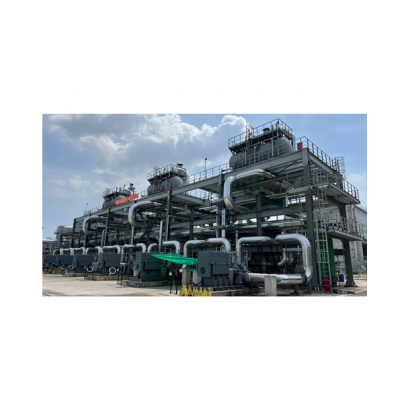
Lithium Bromide Absorption Heat Pump
Lithium bromide absorption heat pumps, which operate based on the same principles as absorption chillers, have recently gained attention as an effective solution for large-scale heat recovery projects—particularly in upgrading low-grade waste heat into usable thermal energy. These systems are especially advantageous in industrial applications where maximizing energy efficiency is critical.
Absorption heat pumps are typically classified into two types:
Type I – Heat Booster (Heat Addition): Driving heat temperature > Output heat temperature
(Heat quantity increase / Waste heat upgrading)
Also known as a heat-boosting absorption heat pump, this system primarily utilizes a high-temperature heat source (such as steam) to drive the cycle, transforming low-temperature waste heat into a large amount of usable medium-temperature heat.
Uses a small amount of high-grade thermal energy (e.g., steam below 8 barg)
Elevates low-grade waste heat (around 50–70 °C) to a useful range (70–110 °C)
Ideal for large-scale industrial heating or district heating networks
Heat balance example:
100% high-temperature driving heat + 80% low-temperature waste heat
→ yields approximately 180% useful medium-temperature heat output
Primary benefits:
Significantly reduces steam consumption for heating
Additional benefit: lowers cooling water temperature
Type II – Temperature Lifting (Exergy Upgrade): Driving heat temperature < Output heat temperature
(Temperature lift / Waste heat utilization)
Also known as a temperature-lifting absorption heat pump, this system utilizes medium-temperature waste heat and upgrades its thermal quality, allowing for reuse at higher temperature levels.
Uses medium-temperature waste heat (80–100 °C) as the driving source
Releases part of the heat to the environment via cooling water
Delivers the remainder as higher-temperature output heat
Two-stage operation examples:
Stage 1 Output Temperature: approx. 110–150 °C
Stage 2 Output Temperature: up to approx. 170 °C
Heat balance:
Stage 1: 100% input – 50% lost to cooling = 50% high-temp useful heat
Stage 2: 100% input – 70% lost = 30% high-temp useful heat
Common applications:
Widely used in chemical plants for top-column heat recovery in distillation systems. It can replace traditional top condensers while simultaneously supplying steam for other processes.

 Lithium Bromide Absorption Heat Pump